

My name is Mario and I live in Montijo, a quiet town just across the Tejo river from Lisbon. By profession, I work with information systems — a world built on logic, structure, and predictability. Photography entered my life as the complete opposite of that.
I wouldn’t call myself a photographer in the classic sense. I’m simply a person who enjoys taking photos and sharing my perspective with the world. I’m also passionate about the post-processing stage. I love giving photos a personal twist and navigating the creative decisions that help amplify the impact of what I’m trying to showcase. Building a distinct visual identity is something I’ve been working on for a long time.


RIGHT: Fuji X100S . F/2.0 . 1/750″ . ISO 400
I’ve been around cameras long before they found their way into our phones., but it was my first trip to New York that truly sparked my love for this art form. I took my first mirrorless camera with me — the original Sony A7 — paired with a couple of vintage lenses.
I found myself constantly shooting, capturing everything and everyone around me, especially my friends. There was something special about it all — one of those rare moments where you feel like you’re living inside a dream, knowing it’s something that will stay with you for the rest of your life. From that moment on, photography became more than just a casual interest.
Some time later, I discovered Fujifilm. When the X-T3 was released, I couldn’t help but feel intrigued by the system – the design, the colors, the philosophy behind it. Soon enough, I found myself owning two Fujifilm cameras: the X100S and the X-T20. At first, they were meant to be secondary tools, backups, or cameras for less demanding situations. At the time, I still believed that full-frame was necessary to achieve a more “professional” look.


RIGHT: Fuji X100S . F/2.0 . 1/420″ . ISO 800
That idea didn’t last long.
Before I knew it, I had sold my entire full-frame system and fully committed to Fujifilm.
Over time, several cameras came and went, as they always do. Each one tied to a different phase, a different version of how I approached photography. But one of them never left, it stayed with me all along, until now.
And this story is about that camera, and its final journey with me.
On the last day of 2025, I found myself driving through the Serra da Lousã, heading towards a small village I had visited before. That place had left a strong impression on me. On a previous visit, I had stayed overnight in one of the few houses available for rent. Falling asleep and waking up in that setting felt almost surreal—quiet, timeless, and deeply atmospheric.


RIGHT: Fuji X100S . F/2.0 . 1/1000″ . ISO 200

The village is called Talasnal, one of the most iconic schist villages in central Portugal.
Tucked into the mountains near Lousã, Talasnal is part of a network of historic villages built almost entirely from schist stone, a dark, textured material that gives the village its distinctive character. For many years, like so many rural places in Portugal, it was gradually abandoned as people moved to larger cities.
But Talasnal didn’t disappear.
In recent decades, it has been carefully restored. Unlike many places that lose their identity in the process of modernization, Talasnal has been brought back to life with a strong respect for its origins. The houses have been recovered using traditional materials, the narrow streets preserved, and the overall atmosphere maintained. Today, it stands as a rare balance between past and present, a place where you can feel history without it being staged.


RIGHT: Fuji X100S . F/2.0 . 1/60″ . ISO 400
That authenticity is precisely what draws people in. Not just tourists, but those looking for something quieter, more genuine. And for photographers, it offers a unique canvas, one defined by texture, contrast, and mood.
We arrived just before sunset. I already knew the light wouldn’t last long.
The first time we visited Talasnal, I only brought the X100S. This time, I wanted to try something different. I still wanted to travel light, so I chose one of my smaller cameras, the Fujifilm X-T20, paired with a compact manual lens, the TTArtisan 23mm f/1.4. Of course, this choice was also influenced by the fact that I would be selling the camera just a few days later.

Newer cameras had joined the family, and the X-T20 had been spending more time on the shelf than ever before. I felt it was time to part ways, even though it was the camera that first introduced me to Fujifilm. It deserved to make someone else as happy as it once made me. I also own an X-E2, which ticks the same boxes — small, lightweight, and featuring one of those older sensors I’ve grown to love.
I grabbed my camera and started walking towards the village.
As if Talasnal needed any help, it felt even more magical than I remembered.


RIGHT: Fuji X-T20 . TTartisan 23mmF1.4 . F/1.4 . 1/150″ . ISO 400

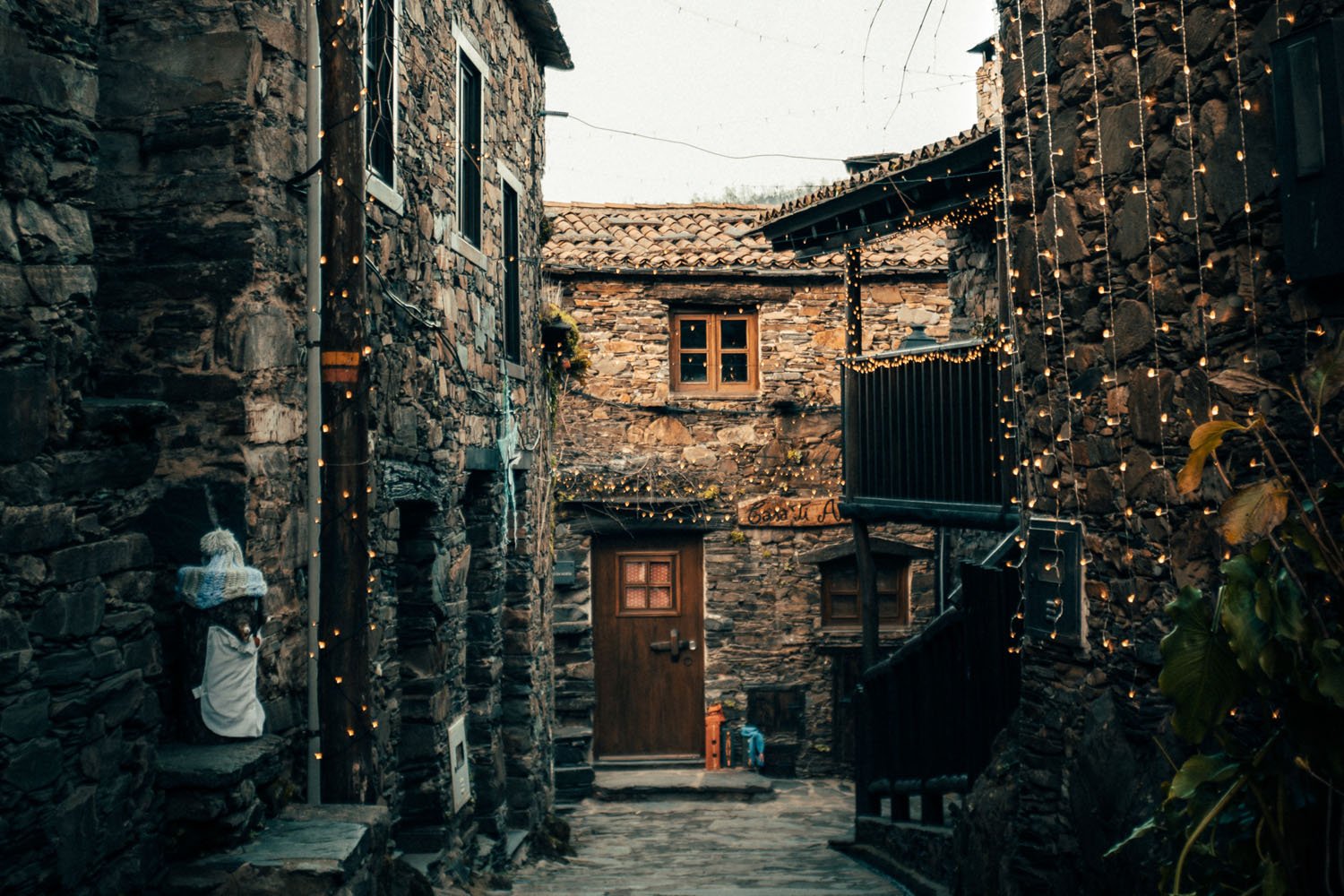
Christmas decorations were still hanging across the streets. Small warm lights had just begun to turn on, softly illuminating the dark stone walls. Smoke drifted slowly through the air from nearby fireplaces, adding a subtle haze that softened the scene. Somewhere in the village, a group of people — perhaps old friends reunited for the holidays — were celebrating loudly, their voices echoing through the narrow alleys. It felt like stepping into a moment suspended in time.
Almost instinctively, my right index finger turned the camera on.
I moved through the narrow streets, taking photos while there was still light. I was more selective and more focused than usual, I knew time was of the essence.
I looked for contrast — between light and shadow. I focused on the houses and streets that stood out for their character, their textures shaped by time. The soft winter light cast deep shadows along the stone walls, while the warm glow of decorative lights brought just enough life to the scene. I also noticed small details that I felt complemented the overall story.


RIGHT: Fuji X-T20 . TTartisan 23mmF1.4 . F/1.4 . 1/1100″ . ISO 400

Photographing in a place like Talasnal at that time of day comes with its own challenges. The streets are narrow, the light is limited, and the dark tones of the schist absorb much of what remains. It pushes you to be more intentional, to observe more closely, and to work with what the environment offers rather than trying to control it.
And that’s what I tried to do.
Very quickly, the light faded into the darkness of the night. I took a few final shots, then put the camera away, letting myself fully take in and enjoy the moment.


RIGHT: Fuji X-T20 . TTartisan 23mmF1.4 . F/1.4 . 1/500″ . ISO 400


RIGHT: Fuji X-T20 . TTartisan 23mmF1.4 . F/1.4 . 1/280″ . ISO 400
There was something special about ending the year there, as well as closing a chapter with my beloved X-T20. It was the last shoot. In that quiet, dimly lit village, surrounded by stone, light, and distant voices, it felt like the perfect way to move on, to close one chapter and embrace the next.
Since then, I finally got the Fujifilm camera that caught my attention in the first place, the Fujifilm X-T3, which has now taken the place of my previous X-T20. It makes more sense to me now, as I own some of Fujifilm’s newer WR lenses, which really benefit from the more capable autofocus system of the X-T3.
I still miss the X-T20 sometimes. And that’s okay.

The post The Last Shoot: A Fujifilm story in Talasnal appeared first on Fuji X Passion.