

“And God said: Let there be light. And divided it from darkness.”

The oldest creation narrative in Western literature opens not with earth, not with water, not with life. It opens with light. Whoever wrote that line — in whatever tradition, in whatever century — understood something important. Not: let there be a source of light. Not: let there be illumination. Simply: let there be light. As a thing. A primary thing. And then, immediately, its division from darkness. Because light is only fully itself at its boundary. Darkness is not light’s failure. It is light’s definition.
We don’t know who wrote it. That anonymity makes it more interesting, not less. It was a human being who looked at existence and understood that light was not a condition of seeing. It was the first fact.

We have spent the history of photography forgetting this.
Golden hour. The soft diffusion of an overcast sky. North-facing studio windows. The precise angle of a reflector. The controlled output of a strobe. We built entire disciplines around the pursuit of light that behaves — light that flatters, that reveals, that cooperates. We speak of good light and bad light. We wait for it, chase it, manufacture it.
But underneath all of this runs one assumption: that light serves the photograph. That light is what we use.
But look at what the greatest painters understood, centuries before photography existed. They didn’t treat light as a servant. For them, light was the subject. The primary object. This is not a new idea. We are the ones who sometimes forgot it.
Caravaggio, in 1600, painted The Calling of Saint Matthew. A dark room. A shaft of light entering from the right. That shaft of light is the painting. Everything outside it simply disappears. He didn’t use light to show us the scene. Light is the scene.1
Rembrandt understood the same thing. His portraits are studies in what light chooses to reveal and what it allows to vanish.
Vermeer took it further still — quieter, more domestic. Woman Reading a Letter shows a woman standing by an unseen window, morning light falling on her face and jacket. No drama. Just light entering a room.2
Hopper’s Sun in an Empty Room, three and a half centuries later, is the same painting. Different country, different century, same understanding.3
Light was always the subject. The figures were secondary.
Edward Hopper said it directly. Early in his career: “What I wanted to do was to paint sunlight on the side of a house.” Not a house. Sunlight. His final major painting, Sun in an Empty Room (1963), is exactly that. A room. Two windows. Light falling on a wall and floor. No people, no story. He spent forty years painting human figures in light. At the end he removed the figures. When asked what he was after, Hopper answered: “I’m after me.”
In photography, Man Ray made it literally true. His Rayographs — made in Paris in the 1920s — were created without a camera. He placed objects directly on light-sensitive paper and exposed them to light. No lens. No viewfinder. No composition in the traditional sense. Just light, objects, and the image that light made by itself. They are, in the most direct sense possible, photographs of light.4
Ansel Adams spent a career building a system — the Zone System — entirely dedicated to understanding and controlling how light translates into a photograph. Not how to find a beautiful subject. How light behaves.
These people were not chasing good light. They understood that light was the work.
So, is light the object? The answer, history tells us, is yes. Light is the object. It always was. The question is only this: did I see it too?
So, I went through my archive. Years of photographs, different places, different light, different circumstances. Can I prove what I just said? Did I learn something from the greatest?
The images in this article are my answer.
No conditions were waited for. No light was rejected.
I. LIGHT UNCONTAINED

There are moments when light refuses all containment. It fills the entire sky. It rewrites the clouds. It turns a city into a constellation. It splits the darkness with violence that has no human author.

We call these moments dramatic. We call them golden. Once-in-a-lifetime. But in doing so, we place ourselves at the center — as witnesses, as lucky catchers of something that graced us.
Look again. The sunset over the sea doesn’t need a witness. The full moon above ten thousand city lights was there before the city and will be thereafter. The lightning was not performing for the camera.

This light is not dramatic. It is simply itself, without apology. A classical facade lit from below against a deep blue sky. Street lamps creating warm pools on the pavement. The windows glowing from within. Two kinds of artificial light working at the same time — one declaring the building to the city, one making it habitable from inside. Neither knows the other is there.

And then the lightning. The most violent image in this collection, and the most honest. Here, light is not beautiful or golden or carefully sought. It is force. Purple-white, massive, uncontrolled. Everything below — the restaurant, the umbrellas, the neat human world — becomes irrelevant. This is light reminding us it existed long before we learned to harness it.
The photographer’s job in these moments is not to capture light. It is to get out of the way.
II. LIGHT AND WATER

Water is light’s most willing collaborator. No other surface does so much with what it receives. Give water a single point of light, and it will invent a road, a mirror, a spectrum, a second sky.
The surfer standing in the waves at sunset is standing in light made liquid. The path of gold leading to that figure was drawn by the sun, but completed by ten thousand moving water surfaces, each catching their fraction of it. The figure stands exactly where light points.

The fountain performs the same alchemy differently. Water vapor becomes a screen. Light projects through it, splits into spectrum, frames itself within a natural arch of dark foliage. Three things happen simultaneously: light revealing mist, light dividing into color, darkness giving light a stage. The small human figure at the bottom is a witness to something that organized itself entirely without him

Two bodies of water, two different relationships with light. The pool blazes electric blue-green — artificial, controlled. The sea beyond it is dark, carrying only a long silver streak of moonlight. Above, the moon itself, small and sovereign. Manufactured light shouts. Moonlight whispers. The whisper carries further. The palm trees stand between both worlds, belonging to neither

At dusk, the negotiation is at its most tender. The last natural light — salmon and violet at the horizon. And humanity’s response: the pier illuminates itself, the gardens glow green. Neither has won yet. The pier extends into the last light like an arm reaching for something already leaving.

And then stillness. A fisherman sits at the precise threshold where warm orange meets cool blue. The horizon, the exact line of division between what the day was and what the night will be. The sea mirrors this without being asked. The fishing line extends into silver water like a thread connecting a human being to the last light on the surface.
Water receives all of it. Water remembers nothing. Water is ready again tomorrow.
III. LIGHT THROUGH MATTER

Glass, water, wax, petal, skin, liquid — each transforms light differently. Each takes what arrives and returns something the source never contained.
The wine bottles in a cardboard crate are not a still life. They are a laboratory. Ordinary daylight enters amber and brown glass and emerges as something molten, alive. A color that exists nowhere in the original light. Nobody arranged this. A shaft of sun found some bottles and created something unrepeatable.

Someone holds the bottle up to the light — an instinctive gesture. The bottle becomes a vessel not for wine but for a particular shade of amber-pink that only exists in this specific convergence of glass, liquid, and sun angle. It is an act of examination. Of wonder made physical.

A shaft of sunlight enters the room from somewhere outside the frame. Narrow, precise, deliberate. It travels the entire length of the marble floor and arrives at the base of an amber vase standing in the corner. The vase catches it and blazes orange-gold. The dried grasses above explode into silhouette against the white wall. Light drew a line across the floor and then set fire to everything it found at the end of that line. The floor, the wall, the corner — all secondary. The vase didn’t move. The light found it. This is what light does when a room is quiet, and nobody is managing it.

Two glasses, same shape, same material, same light. Completely different conversations with it. The red wine absorbs — pulls light in, surrenders almost nothing, offers only a few deep crimson glints at the thinnest edges. The rosé transmits partially, glowing softly, filtering light into something gentler. Same light. Two different negotiations. This is not about wine. It is about what matter decides to do with what it receives.

The cherries are almost black. Deep purple-burgundy that absorbs nearly all light. Yet each one carries a single sharp point of pure white where the sun touches the skin. The hand below is warm, sun-caught, generous with light. The cherries hoard their darkness and surrender only that single gleaming point each. This is light signing its name on things that resist it.

The rose held in cupped hands is not lit — it glows, as if the light were originating inside the petals rather than falling on them. The hands are half-shadow; the background dissolved into deep green darkness. Light has selected the flower and ignored almost everything else. This is light as editor — choosing what exists, choosing what matters.

The blueberries on the bush are a calendar written in light. Each berry records its own relationship with the sun. The unripe one’s pale pink and white, still resistant. The ripening ones deepening through lavender to purple. Light here is not just falling on the fruit. It is measuring time. One frame contains the entire arc of a summer — beginning, middle, and end — written in color and absorption.

And then the opposite. Fruit that doesn’t resist light at all. The yellow cherries hang against a white sky, backlit. Light passes through them rather than bouncing off them. They become briefly translucent, warm amber-gold, luminous from within. The leaves catch the same light and blaze green. This is light passing through entirely — the fruit becoming, for one moment, a lamp of itself.

Light doesn’t always hide inside a flower. Sometimes it explodes outward from the center in visible rays — white-green at the origin, spreading through deep purple petals that darken toward the edges. The flower is both source and absorber. This is light as origin, as the point everything moves away from.

The orange blazes yellow where light strikes it, every pore a separate decision about how much to return. But look behind it. The screen’s surface caught its reflection and transformed it beyond recognition. Same shape, same fruit, same moment. Without light: a dim, distant, almost unrecognizable sphere. The reflection doesn’t show what the orange looks like. It shows what the orange looks like without light deciding it should exist.

The most ordinary image in this collection. Two pieces of fruit on a kitchen table. Light coming through a window. Hitting them the way it hits things in every house, every afternoon, everywhere. No arrangement. No drama. Just light finding what was there and making it briefly, completely present. This domestic miracle happens without witnesses ten thousand times a day. You don’t need to go anywhere. Light is already at work.

Light finds its way into everything. Inside a glass, at the precise moment ice meets the liquid, something extraordinary happens at a scale the naked eye barely registers. The amber of the whisky becomes a surrounding world — warm, golden. Where ice meets liquid, light catches in the turbulence: bubbles, crystalline fractures, foam. Each tiny structure refracts differently. Light in its most private theater — illuminating a world that exists for seconds and never exactly again.

The blue flame beneath the pot is almost overlooked. The eye goes immediately to the boiling water above; the sausages submerged in white foam. But the flame is the engine of everything happening in this frame. Light as hidden cause, upstaged by its own effects. You have to look for it. It was there first.
Of all light’s relationships, its longest is with the living world. Stone absorbs light. Glass bends it. Water reflects it. But nature responds to it — grows toward it, times itself by it, changes color as it accumulates. A cherry ripens in direct proportion to the light it receives. A flower opens and closes on a schedule the sun sets. A tree spends a century reaching upward. This is not poetic observation. It is biology. Light and the living world co-evolved, each shaped by the presence of the other. When we photograph nature in light, we are not choosing a subject. We are pointing a camera at a relationship four billion years in the making.
IV. LIGHT AND ARCHITECTURE

The architects knew. Long before photography, long before electric light, the builders of corridors and cloisters and refectories understood that light was not decoration. It was structure. The window was not an opening in the wall. It was a decision about what would exist inside and where.
The dark corridor — stone floor, wooden ceiling, a single lamp of no consequence — and at the far end a rectangle of pure white light. This image operates before thought. Light at the end of a passage is one of the most ancient human experiences. We respond before we decide to. We move toward it without being asked.

The same argument made outdoors, with more violence. Foreground darkness total and absolute. Then, through the ancient stone arch — a sunlit alley blazing with afternoon light, a wooden door, yellow walls, ordinary life. The arch frames it like a painting nobody commissioned. Shadow and sun met at this particular opening on this particular day. The darkness here is not emptiness. It is the condition that makes the light at the end visible.

The cloister operates differently. Light is admitted rhythmically, through arched openings that throw precise ellipses of sunlight onto the terracotta floor. Two figures walk through alternating pools of light and shadow, becoming and unbecoming visible with each step. The architect designed this in the fifteenth century. The light still follows the instructions exactly. Six hundred years of the same performance, daily, without variation.

The refectory is light rationed by intention. A barrel-vaulted ceiling, long stone tables, small windows on one wall. Each window a deliberate decision about how much light to allow and where. Those windows were not decorative. They were legislative. Light here feels as if it arrived with the building rather than through it.

Underground, the calculation inverts entirely. No daylight reaches the stone tunnel. Light here is carried in, artificial, warm against ancient walls. Arches recede into amber glow. The rough texture of centuries made visible by illumination that has no business being this beautiful. Light as pure necessity. Except that necessity this complete becomes its own beauty.

And here light makes architecture argue with itself. A modern glass facade reflects an ancient cathedral. The stone spires bent and warped across curved surfaces. The modern building has no face of its own. It exists as a mirror, showing something older and more permanent in distorted form. Two buildings, one light. Between them: a third image that belongs to neither.
When the building was designed around the light — who is really the architect?
V. LIGHT AT ITS LIMITS

This is where the argument becomes most honest.
The candle, not yet consumed. Walls still intact, still pretending to be an object. But light is already winning. The wax glows from within, translucent, the flame visible as a crescent through the walls. The object is still present. Light has already begun its work.

Another candle. The walls have thinned to almost nothing, burned away by the very flame they were made to carry. What remains is not a candle anymore. It is a shell of light, a lantern of itself. The object surrendered entirely to the thing it was meant to contain. Light won. Given enough time, light always wins.

Two light sources in direct competition. The full moon, ancient and indifferent. The street lamps below, municipal and dutiful. Neither wins. The building facade sits between them, lit from both above and below, belonging to neither world. Different origins produce fundamentally different qualities of presence. The moon doesn’t illuminate. It presides.

The least arranged image in this collection — and perhaps the most surprising. Strong backlight turned a mundane act into something luminous. The plastic bottle blazes with refracted light, water droplets catching the sun independently. The woman’s face recedes into shadow. The container of water becomes the subject. The person disappears; the vessel blazes. This is the thesis made accidentally, in the middle of an ordinary afternoon.

A shadow falls across a flower bed — and the shadow is the subject. The photographer is present only as darkness, as the absence of light cast by their own body. The yellow tulips outside the shadow blaze. The flowers inside it are dimmed, cooled, changed. The photographer is made of shadow. While we chase light, we cast darkness. We are not neutral observers. We are participants in the shadow.


The same scene. Minutes apart. In the first frame, the sun is still present — buildings retain color, people visible on the sand, the world has texture and detail. In the second frame everything collapsed into silhouette. The sun a small white disc in amber nothing. The buildings gone. The people gone. The color gone.
We are not photographing places. We are photographing light’s current relationship with surfaces. Change the light and you don’t have a different photograph of the same place. You have a photograph of a different place entirely.

The sun has not set. It is present, visible, technically still day. But haze has diffused it across the entire sky, flattened the world to a single tonal register of grey-brown. The palms, the water, the buildings — all reduced to the same value. No shadows. No contrast. No edges defined. Light surrendering its defining power without disappearing. Not darkness. Something stranger — light that has stopped making decisions.

The lone figure in the night plaza stands at the intersection of every light source that couldn’t agree. Warm commercial glow from the right, cool ambient reflection from the wet floor below, distant urban orange from beyond. The wetness doubles everything. The person is small, anonymous, caught between competing illuminations that have no interest in them. Light indifferent to human presence. Not cruel. Simply elsewhere. Having its own concerns.

A face at a window — but not quite. The glass returns a reflection overlaid with winter trees beyond and the warm lamp in the room behind. Inside and outside simultaneously. The face is present but ghostly, made partially transparent by competing light sources. The person is there and not there. The portrait complete and incomplete. Light has made presence ambiguous.
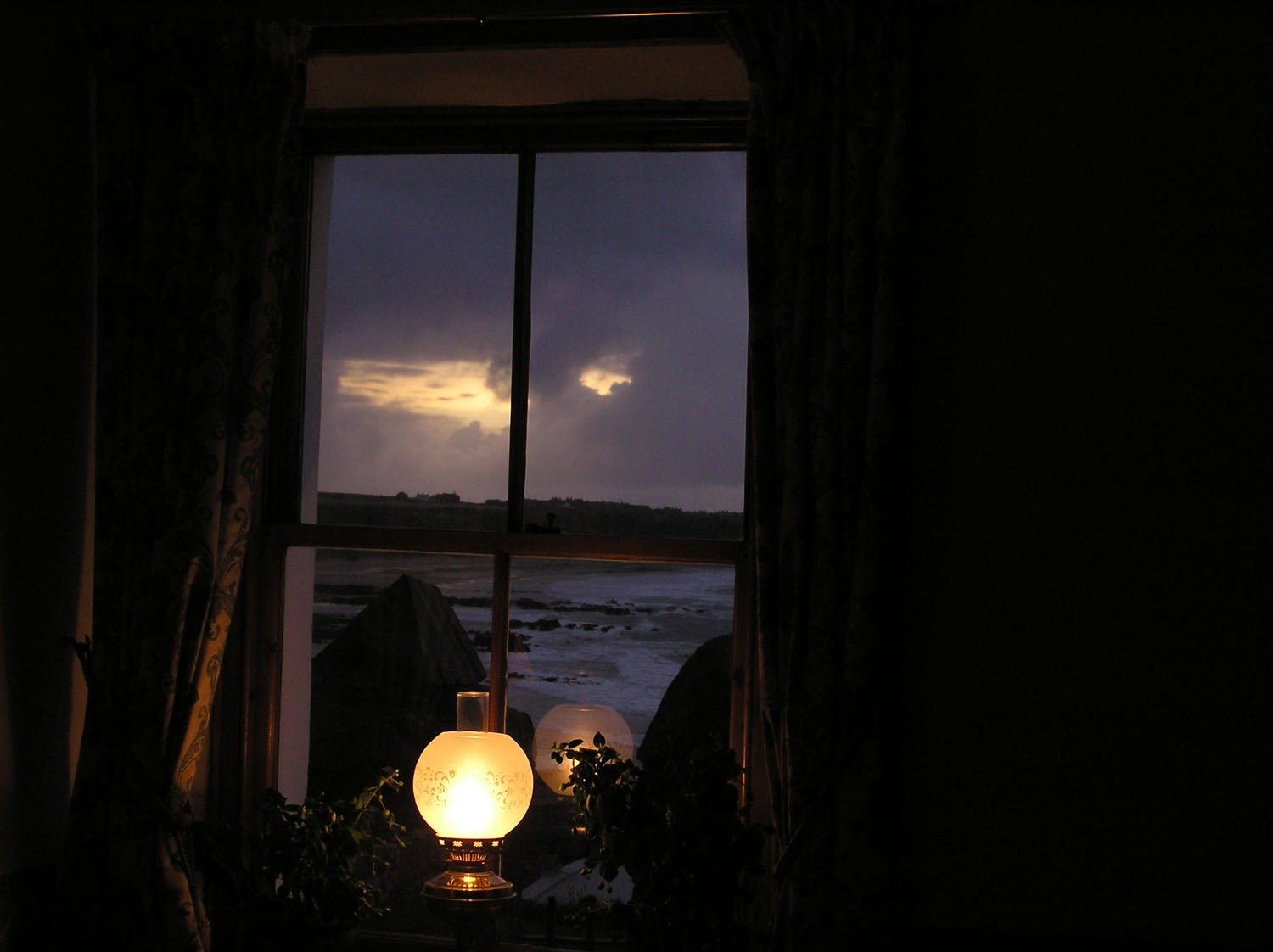
Outside the window: clouds that have almost extinguished themselves, two pale patches of struggling sky, a rough sea, a landscape that surrendered most of its light. Inside: a single oil lamp, small and warm, glowing in a room it cannot fully reach. The darkness around it is almost complete. The lamp doesn’t compete with what’s outside. It doesn’t try. It simply persists — the oldest human response to darkness, unchanged in form for centuries. Not failing. Not triumphant. Just present, barely. Which is sometimes enough.

The menorah. The oldest light technology we still use, unchanged for three thousand years. No electricity. No glass. No architecture required. Just wax, wick, and fire — the same fire that lit the first corridor, the first room, the first human attempt to push back against darkness.
After everything — the lightning, the moon over cities, the sun dissolved in haze, the light trapped in glass and petal and water and stone, person shadow falling across yellow flowers, the small lamp holding its ground against a winter storm — we arrive here. At a kitchen table. At few small flames.
This is light as memory. Light as intention. Light as the human answer to darkness. Made with the simplest possible means. Repeated in every generation. Because some things need to be said with fire.
The photographer who waits for good light will make good photographs.
The photographer who understands that all light is the subject will make something else entirely.
We were told this at the beginning — by whoever first looked at existence and understood that light was not a condition of seeing, but the first fact of being. Not a tool. Not a quality. Not a mood.
A thing.

You can look at what light is doing right now, in this room, on this surface, at this ordinary unrepeatable moment.
It is always already the object.
It is always already enough.
For 200 years, photography has said: “Use light to show the world.” Now let us say: “Use the world to show the light.”
Light in our lives keeps us alive.
References:
- Caravaggio, The Calling of Saint Matthew (1600) — en.wikipedia.org/wiki/The_Calling_of_Saint_Matthew
- Vermeer, Woman Reading a Letter (c.1663) — en.wikipedia.org/wiki/Woman_Reading_a_Letter_(Vermeer)
- Edward Hopper, Sun in an Empty Room (1963) — en.wikipedia.org/wiki/Sun_in_an_Empty_Room
- Man Ray, Rayograph, The Metropolitan Museum of Art — www.metmuseum.org/art/collection/search/265487
The post Light as primary object appeared first on Fuji X Passion.