

How I never got a Leica
It struck me like lightning, changed my preferences for how a camera should be. It was love at first sight, and it’s been a love affair ever since.
In 1973, as a young and fumbling street photographer, I had been using my Konica Autoreflex for three years. One day in the photo shop store front, it just stood there, the Leica CL. Small and perfectly shaped, I knew that this was the camera made for me. But reality kicked in fast, the Leica CL was way out of my reach, I just couldn’t raise the money.
The years went by, I upgraded to Canon A1, but the Leica CL and even the Minolta CLE kept on being my idea of the perfect camera, still out of reach.
Fast forward to 2010. The world had gone digital, and Fujifilm presented the X100. A bit bulky in my opinion, and a fixed lens, so that was not for me, but now I had my eyes on Fujifilm. One year later, the X10 was introduced, and I went shopping. The camera was small, had a zoom, and a number of limitations, but I loved it. A year later came the X-E1 and I went shopping again.


RIGHT: Fuji X-E3 . Fuji XF18-55mmF2.8-4 @23mm . F/2.0 . 1/1000″ . ISO 200


RIGHT: Fuji X-E3 . Fuji XF16mmF2.8 . F/2.8 . 1/1000″ . ISO 200

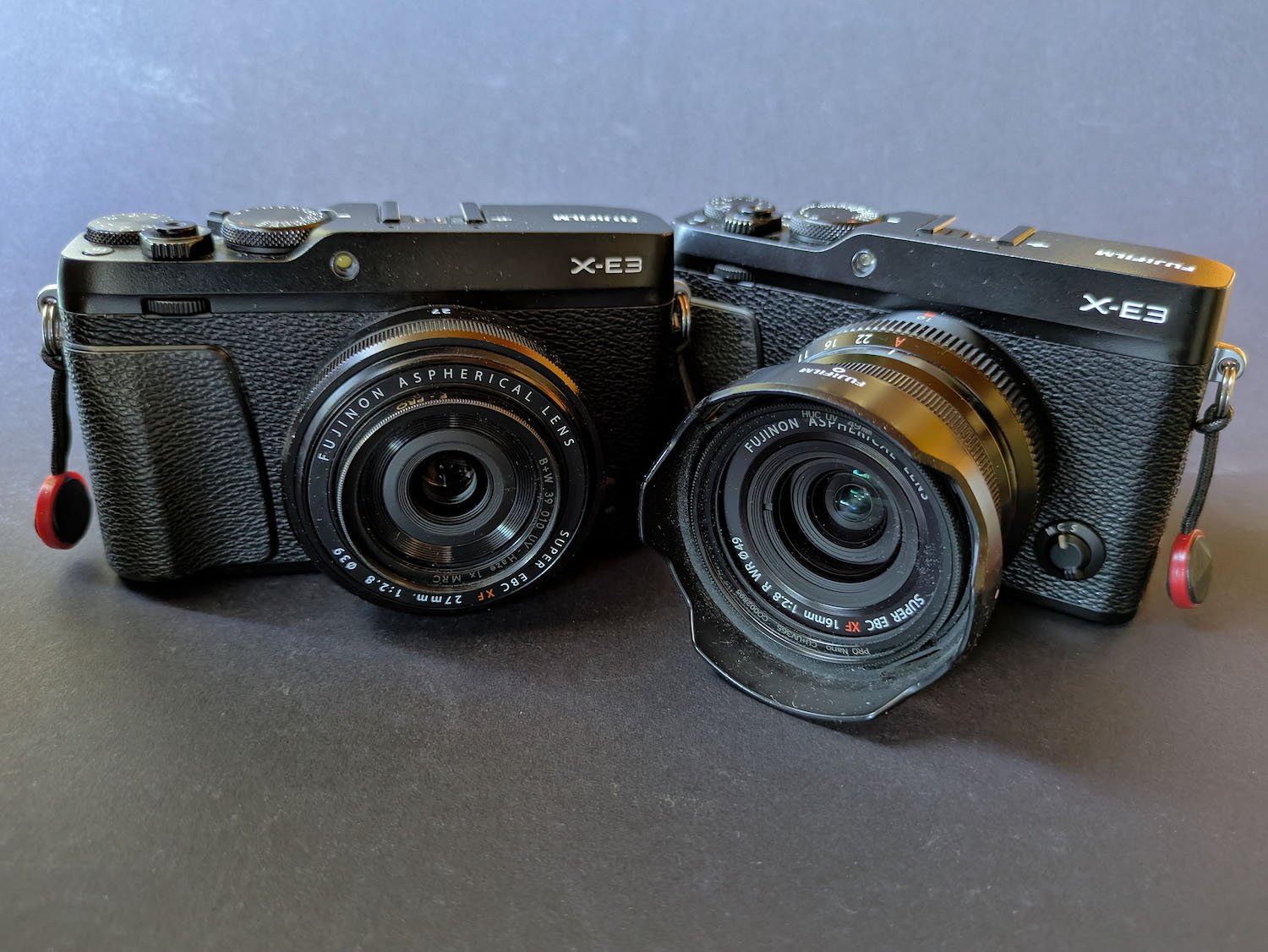
6 years passed. I had tried a few more Fujifilm cameras without feeling 100% happy, but in October 2017 I ordered the newly released X-E3. This was it! A camera so close in size to the Leica CL I almost thought it was a Leica CL reincarnation. Well, it wasn’t. For me, the modern and digital X-E3 was way better than the analogue Leica CL, but it had the looks and the feel that I had been longing for since 1973. My platonic love affair with the Leica CL faded a little bit as my new X-E3 and I became more and more friends. This felt perfect.
It didn’t take long for my X-E3 to be my go-to camera for almost everything. My X10 retired due to dirt inside the zoom lens or on the sensor, dirt that can’t be removed without dismounting the whole camera. And who can fix that today? Not Fuji. My X-M1 stepped down to play the role of backup camera, and my X-T2 was put on the shelf and still to this day wonders why I abandoned it. For almost everything, I picked up the X-E3. I started to wear my X-E3 always. Going out without my X-E3 became almost equivalent to going out without trousers. I felt naked without my X-E3. I loved this camera!
In 2012, I also started a street photography group (www.gatufotogruppen.se), so I needed to step up my photography to be on the same level as my group members. Then it was perfect to have a small camera that I could always bring along.


RIGHT: Fuji X-E3 . Fuji XF16mmF2.8 . F/18 . 1/15″ . ISO 200


RIGHT: Fuji X-E3 . Fuji XF35mmF2 . F/9 . 1/4″ . ISO 400
Issues
Even the most perfect creation has its issues and drawbacks, often based on personal preferences and needs. My major and only issue with the X-E3 is the lack of weather sealing and the consequences related to that. The lack of weather sealing impacts the top of the camera, mainly. It took 18 months for my X-E3 to get a sluggish on/off knob. This came after a number of rain experiences with my X-E3. I didn’t dare do anything to fix this, and my camera was still under warranty, so the camera was sent for service and got a new top plate. After that, I got more careful with my camera and the new on/off knob worked for 6 years, then it was time again for a new top plate. This time I had to pay, and it wasn’t cheap. In addition, I was a bit unlucky, I got a top plate with a faulty LCD/EVF sensor, so again the camera got, now its third, new top plate. Nowadays, I have a solution, not pretty but effective. A plastic bag with small holes for the strap lugs and a rubber band.

Everything else with the camera is robust. All buttons work fine, and the paint is surprisingly strong and free from battle wounds after nearly 9 years of almost daily use.
Aging
A few years ago, when my X-E3 had passed 70 000 exposures, I suddenly got scared. I’m addicted to this camera. What shall I do if this camera dies in my hands? The X-E4 was discontinued, and no X-E5 was in sight. I started to browse the second-hand market, both private sellers and shops selling refurbished gear with warranties. I looked for a black X-E4, but I could also accept an additional black X-E3. The latter was what I found just 5 minutes from our home on my bike. My second X-E3 hadn’t been used so intensively as my first, so I’m happy with that outcome.

Lenses and Adapters
I have a lot of manual lenses. Konica Hexanon from the 1970s and Canon FD from the 1980s and 1990s. When I started using the Canon EOS systems in the late 1990s, I couldn’t convince myself to sell my old manual lenses, that was a too big emotional step to take. Today, I’m happy for this as it’s so easy to adapt old manual lenses to mirrorless cameras. I do that a lot. I even adapted an 80-year-old ROBOT lens. More of adapting very old lenses would be fun.

But above all, I use the Fuji lenses, mostly the ‘Fujicrons’. These small weather-sealed lenses fit so perfectly well on the X-E3. My favorite is the 16mm F2.8, which might not even be a real ‘Fujicron’, but still, it suits me perfectly. I’m also a bit of a cheater. My latest acquisition is the TTartisan 75mm F2.0. A bit big on the X-E3, but I can live with that.
What I shoot
The simple answer is that I’m a street photographer, but a better description is ‘life photographer’, I document life. This started early with my first camera. I didn’t know anything about genres and photo history, it was just interesting to document streets and life in the city. And I’ve never stopped. 99,9% of all my photographic work happens in Stockholm, where I live.
I’m influenced by almost every photographer who works or has worked in the life photography genre, but André Kertész is my absolute favorite. When I’m in that mood, all my shooting turns out to be in B&W.


RIGHT: Fuji X-E3 . Fuji XF16mmF2.8 . F/2.8 . 1/1000″ . ISO 640


RIGHT: Fuji X-E3 . Fuji XF50mmF2 . F/2.8 . 1/120″ . ISO 800
Sometimes my friends remind me that the world is in color. When looking for role models in color photography, it’s hard to neglect Saul Leiter, Martin Parr and the Swedish Lars Thunbjörk.


RIGHT: Fuji X-E3 . Fuji XF50mmF2 . F/2.0 . 1/1000″ . ISO 640


RIGHT: Fuji X-E3 . Fuji XF35mmF2 . F/2.0 . 1/1000″ . ISO 6400
Another photographer who has influenced me is Olga Karlovac. A photographer who absolutely excels in blur. The unsharp perspective on life and things can be interesting above expectation, it makes at least my imagination work harder.


RIGHT: Fuji X-E3 . Fuji XF16mmF2.8 . F/22 . 1/8″ . ISO 200

Post processing
I don’t do much.
I never jumped on the Adobe subscription model. Instead, I left Adobe and gave up my knowledge in Adobe products. This was a decision mainly based upon principles for me. Nowadays, I mainly use Open Source software, and I do the majority of post-processing in Darktable. Occasionally, and for printing purposes, I use GIMP.
X-E5
Finally, Fujifilm released a new X-E camera. For a while, rumors told that the X-E line was discontinued, but luckily it wasn’t. When the price for the X-E5 was revealed, I hesitated, this camera was more than twice as expensive as my X-E3 was in 2017. But inflation, development cost, new features, new sensor, and so on… I ordered one.
Then I was hit by doubt. My so-called friends asked me why I needed a new camera when I only shoot unsharp photos. On top of that, I asked myself why I wasn’t happy with my two X-E3s. I had no good answer to that, so I canceled my order.
I regard myself as an old man with two old cameras, and I’m happy with that. Cameras that I know so well, I never need to think of how they work, my muscle memory takes care of that. Still, future never knows. I might surprise myself by ordering a black X-E5 if rumors say the camera will soon be discontinued. But I’m not sure I will love the X-E5 as I love the Fujifilm X-E3.


RIGHT: Fuji X-E3 . Fuji XF16mmF2.8 . F/4.0 . 1/2000″ . ISO 320


RIGHT: Fuji X-E3 . Fuji XF27mmF2.8 . F/2.8 . 1/15″ . ISO 200


RIGHT: Fuji X-E3 . Fuji XF27mmF2.8 . F/16 . 1/15″ . ISO 200


RIGHT: Fuji X-E3 . Fuji XF16mmF2.8 . F/22 . 1/15″ . ISO 200
The post A love story appeared first on Fuji X Passion.